
Cultivating a Sustainable Future through Falcata.
About Falcata
Falcata (Albizia falcataria) is a fast-growing tree in the legume family. Though its seeds are less than 1 cm wide, they hold immense potential to restore the environment. By cultivating Falcata forests, we actively breath new life into local ecosystems and enrich the global environment.
Native to Southeast Asian islands like the Maluku Islands, New Britain, and the Solomon Islands, Falcata is known globally by several names. In commercial markets, it is often called "Albasia," while in Indonesia, it is widely known as "Sengon".
In Indonesia, Falcata is a primary raw material for plywood and barecore for furniture. Sustainable plantations thrive along the Indian Ocean coast of Central and Eastern Java. Additionally, local farmers plant Falcata around crops and on fallow land, making the tree a crucial source of supplemental income that supports regional livelihoods.


Falcata Seeds

Falcata Seedling

Fully Grown Falcata
Rapid Growth, Exceptional CO2 Capture
In just 7 to 8 years from planting, Falcata grows into a massive tree with a diameter of 40 to 50 cm. Throughout this rapid growth cycle, it absorbs and sequesters vast amounts of CO2, making it a vital species for combating global warming.

Enriching the Soil: The Power of Root Nodule Bacteria
As a legume, Falcata's roots feature small nodules that form a symbiotic relationship with root nodule bacteria (rhizobia). These bacteria absorb nitrogen from the atmosphere and convert it into vital nutrients through a process called "nitrogen fixation". Simply by growing, Falcata naturally fertilizes the soil and enriches the surrounding ecosystem.

Afforestation and Agroforestry
Growing Together: Our Forestry Legacy
Committed to sustainable sourcing, Nankai Plywood began planting trees in Indonesia in 2006. We now manage 26 hectares across three East Java plantation hubs.
While supporting daily living, Falcata products keep captured carbon safely locked away. Our sustainable "farming-style" forestry cycle of growth, harvest, processing, and replanting protects precious natural forests and minimizes environmental impact. We are confident this represents the ideal model for sustainable forestry.


Banaran Plantation

Banaran Plantation

Banaran Plantation
Banaran Plantation
Banaran Plantation
Banaran Village, Kandangan District, Kediri Regency
First cycle launched September 2009; second cycle launched August 2019
Leased from local residents
9.8 hectares
7,135 Falcata trees
51 Kalampayang trees
Banaran was our very first plantation hub on Java. At the time, the community faced a steep outflow of young people migrating to cities in search of work, leaving much of the land partially fallow. To help revitalize the area, Nankai Plywood leased this unused land from local residents for a 10-year period, launching our journey into regional forestry.
We prioritize hiring landowners and local residents for all essential plantation operations, including fertilizing, planting, weeding, pruning, and harvesting. In a region with historically limited job opportunities, this project plays an important role in providing stable, reliable employment.
Now in its second cycle, the plantation leverages our past experience by adopting a wider 3 by 4-meter spacing to optimize tree development . In certain areas, we utilize coppice regeneration, allowing new shoots to grow directly from the harvested stumps of the first cycle. Remarkably, some of these regenerated trees have reached a diameter of over 50 cm in just six and a half years.
Lumajang Plantation
Sumberwuluh Village, Candipuro District, Lumajang Regency
First cycle launched April 2011; second cycle launched 2022
Company-owned, adjacent to Lumajang factory
10.2 hectares
1,037 Falcata trees
2,519 Kalampayang trees
This company-owned plantation is located directly on the grounds of our Lumajang Factory, Nankai Plywood’s primary hub for barecore production. While Falcata is cultivated widely across the Central and Eastern Indian Ocean coasts of Java, Lumajang Regency is celebrated as the premier production center for high-quality Falcata timber.
At this site, we actively plant Kelampayan alongside Falcata. Like Falcata, Kelampayan is a fast-growing, sustainable tree species with a minimal environmental footprint. Thanks to the exceptionally fertile soil at Lumajang, the richest among all our managed plantations, the trees here exhibit truly remarkable growth rates. The plantation has now successfully transitioned into its second forestry cycle.

Sumberwuluh Plantation, adjacent to Lumajang Factory

Sumberwuluh Plantation

Sumberwuluh Plantation
Sumberwuluh Plantation, adjacent to Lumajang Factory

Jombok Plantation

Jombok Plantation

Jombok Plantation
Jombok Plantation
Jombok Plantation
Jombok Village, Ngantang District, Malang Regency
First cycle launched October 2011; second cycle launched February 2019
Company-owned
8.3 hectares
4,684 Falcata trees
Like our other sites, the Jombok plantation originally launched with a strong focus on community employment, actively hiring local residents for forestry management and operations.
When launching our second forestry cycle, local residents approached us with a request to cultivate the open spaces between the trees. Recognizing this as an opportunity to maximize the land's potential and bring greater economic benefits to the community, we opened the plantation to approximately 50 local households. This marked our official introduction of agroforestry, integrating agricultural crops directly within our plantation.
To make this partnership a success, the farmers strategically adapt their crops based on Falcata’s specific growth stages, as detailed in the following section.
Case Study of Our Agroforestry Initiatives at Jombok Plantation
Crop Evolution Based on Tree Growth
From the time seedlings are planted until they reach 1 to 2 meters in height, farmers utilize the open underspace to cultivate chili peppers, shallots, garlic, and peanuts . As the Falcata trees grow and cast more shade, the crop shifts to corn.
Once the trees exceed 4 meters and begin forming a mature canopy, farmers switch to Napier grass, a livestock feed crop that thrives in shaded conditions . Today, with many of our trees towering over 10 meters, vast fields of Napier grass spread beneath them, serving as an invaluable source of continuous income for local families.
The Harmonious Relationship Between Humans and Trees
Agroforestry goes far beyond efficient land utilization; it is a system of true mutual growth. The daily care provided by local residents for their crops, including tilling, weeding, watering, and fertilizing, inherently accelerates the healthy development of the surrounding Falcata trees.
In return, Falcata converts atmospheric nitrogen into a "natural fertilizer" via its symbiotic root nodule bacteria, enriching the soil to support crop growth.
Human care nurtures the trees, and the natural power of the trees nurtures the crops . This ecosystem at the Jombok plantation perfectly embodies the ideal form of agroforestry, where nature and the local community thrive hand in hand. Moving forward, we will continue to collaborate closely with local residents to protect and cherish this sustainable cycle.
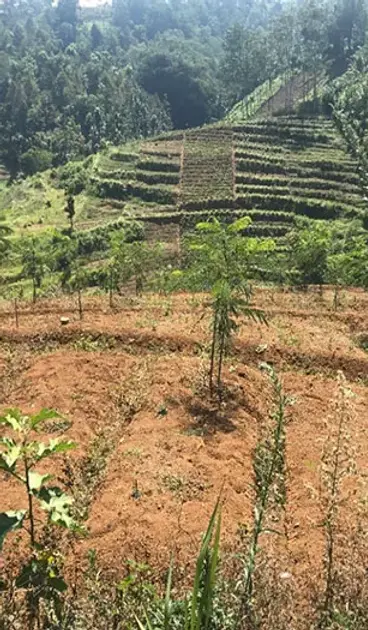
Jombok plantation, just as the second plantation cycle was launched (2019)

Combined Cultivation of Corn and Peanuts (2020)

Cultivation of Shallots (2020)

Cultivation of Napier Grass (2021)
Our Commitment to the Environment and People
Beyond our sustainable materials and forestry initiatives, we strive to realize a sustainable society through every aspect of our corporate activities. We view climate action as a critical management priority and are deeply committed to reducing our carbon footprint.
We continuously implement measures to lower our carbon emissions, such as installing solar panels for on-site energy consumption at our manufacturing facilities and transitioning to LED lighting. In tandem with boosting operational productivity, we have reformed employee working styles and introduced optimized shift-work systems at our overseas factories. These initiatives have successfully improved our team's work-life balance while significantly reducing the energy required to power our business operations .
Through these sustained initiatives, we have achieved measurable progress compared to our baseline average (FY2020–2022) :
-
FY2023: 12% reduction in emissions
-
FY2024: 16% reduction in emissions
Looking to the future, we have set a clear target to consistently maintain an emissions reduction of at least 5% below our baseline. We will continue to drive sustainable corporate management and minimize our environmental footprint.

Solar Panels Installed at Shido Factory

Implementing LED lighting at our manufacturing hubs

Realization of Better Work-Life Balance
Resulting in Reduced Power Consumption